
ChristopherAlexander가 질서의 본질적인 특성 (Nature of Order)에 대해서 저술한 책. PatternLanguage에 대해서 정리한 그는, 패턴을 마구잡이로 적용하는 경우가 많은 것을 발견하고, 어떤 원리에 따라 구성해야 자연의 미를 살려낼 수 있을까 생각했다. 이 책은 사물이 자연스럽게 성장하는 방법에 대해 기술하고 있다.
책은 총 네 권으로 되어있다.
/The Phenomenon of Life (생명의 현상)
/The Process of Creating Life (생명을 탄생시키는 과정)
/A Vision of a Living World (살아있는 세계에 대한 비전)
/The Luminous Ground (빛나는 토대)
This four-volume work is the culmination of theoretical studies begun three decades ago and published in a series of books -- including The Timeless Way of Building and A Pattern Language -- in which Christopher Alexander has advanced a new theory of architecture and matter which has attracted thousands of readers and practical followers throughout the world. He has tried to grasp the fundamental truths of traditional ways of building & to understand especially what gives life and beauty and true functionality to buildings and towns, in a context which sheds light on the character of order in all phenomena. *** The four books redefine architecture as we know it. Each of the books is independent, and deals with one facet of the problem. Taken together the four books redefine the cosmology that provides architecture with its underpinning; they redefine the procedures of planning, design and building; they redefine the style, the shapes of buildings and the forms of construction. Here is an entirely new way of thinking about the world, one likely to enter fields as diverse as computer science, sociology, philosophy, and art. As one writer has expressed it, 밫he books provide the language for the construction and transition to a new kind of society, rooted in the nature of human beings.
The four books are connected and interdependent. Each can be read by itself, and sheds light on one facet of the problem of living structure: First the definition, second the process of generating living structure, third the practical vision of a world made of living structure, and fourth, the cosmological underpinnings and implications caused by the idea of living structure.
They offer a view of a human-centered universe, a view of order, in which the soul, or human feeling, and the soul, play a central role. Here, experiments are not only conceivable in the abstract Cartesian mode, but a new class of experiments reveal the foundation of all matter, and all process, as being something which resides in human beings. Whether this something, which is demonstrated and used throughout the four books, is a new entity underlying matter, or what used to be called the 뱒oul, is left for the reader to decide.
The four volumes have been written so that each stands alone as an independent book, and may be read without benefit of the others. At the same time, the full meaning of the four books, and the architectural, social, and cosmological scheme they introduce, can only be understood by seeing the interplay of these four complementary points of view.
The Phenomenon of Life
In Book 1, Alexander defines life as the necessary criterion for quality in buildings. Starting with an analysis of the arbitrariness of present-day architecture, and going to the root of functional order in the world, he proposes a scientific basis for looking at life as an objective concept that is rooted in structure. The book shows living structure in good buildings and bad; human artifacts; and natural systems, and discusses the presence of the same living order in all systems. It is proposed that living structure, or living order, depends on features which make a close connection with the human self, and a way of regarding living structures makes them amenable to empirical treatment. The quality of works of art, artifacts, buildings is defined, not merely in terms of living structure, but also in their capacity to affect human growth and human well-being.
이 권에서 그는 15개의 형태적 특성(15 Properties of Natural Morphology)에 대해 정리한다.
크기의 단계들 Levels of Scale
강한 중심 Strong Centers
경계들 Boundaries
교차적으로 일어나는 반복 Alternating Repetition
긍정적인 공백 Positive Space
- 국지적인 대칭성들 Local Symmetries
- 좋은 모양 Good Shape
- Deep Interlock and Ambiguious
- Contrast
- Gradients
- Roughness
- Echoes
- The void
- Simplicity and Inner calm
- Not-Separateness
The Process of Creating Life
In Book 2, Alexander examines the kinds of process that are capable of generating living structure. The unfolding of living structure in natural systems is first compared to the unfolding of buildings and town plans in traditional society, and then contrasted with present day processes. The comparison reveals deep and shocking problems which pervade the present day planning and construction of buildings. He describes the detailed character of living process needed to generate, design, plan, and build buildings with living structure. The character of living process is contrasted, repeatedly, with the character of present-day professional process, which departs, again and again, from present process, in order to meet the necessities inherent in any truly life-creating process. Pervasive changes needed to create a world in which living process and hence living structure are attainable only through a transformation of society. The dynamic methods of Book 2, focusing on process, give an entirely different picture of the facts and concepts presented in Book 1.
A Vision of a Living World
In Book 3 Alexander presents hundreds of his own buildings and those of other contemporaries who have used similar methods consistent with the theory of living process. The projects include neighborhoods, housing built by people for themselves, public buildings, public urban space, ornament, colors, details of construction innovation. The many buildings shown in Book 3, and the methods needed to design and building these buildings, shed light on the phenomenon of life, on the nature of living structure, and make it more practical, more graspable. Six hundred pages of projects built and planned over a thirty year period, including many un-built experiments, illustrate the impact which is likely to follow from the use of living process in the world. The book provides the reader with an intuitive feel for the kind of world, its style and geometry, which is likely to follow, together with its ecological and natural character. It closes with an assessment of the archetypal character such a new, living world, is likely to reveal.
The Luminous Ground
In Book 4, the culmination of the quartet, Alexander addresses the cosmological implications of the theory he has constructed and presented. The book begins with a critique of current cosmological thinking, and its separation from personal feeling and value. The outline of a theory in which matter itself is more spirit-like, more personal in character, is sketched. The cosmological modifications presented in Book 4, are needed, to supplement the definition of the personal nature of matter, design, and form, and acts as a substrate for an attempt to implement living process. The book contains a long chapter, nearly one hundred pages long almost a book in itself in which Alexander presents his theory of color, as one ingredient of the new cosmological picture which he puts forward. This volume draws attention to new ways of looking at consciousness, and modifies physical theory so that the human person what we know as self, and what Alexander calls the enters in as a fundamental and necessary ingredient of all matter.
Prologue: to books 1~4
참고
손영수씨의 정리
다른 후기
Buidling Beauty의 세미나
나름대로의 해설
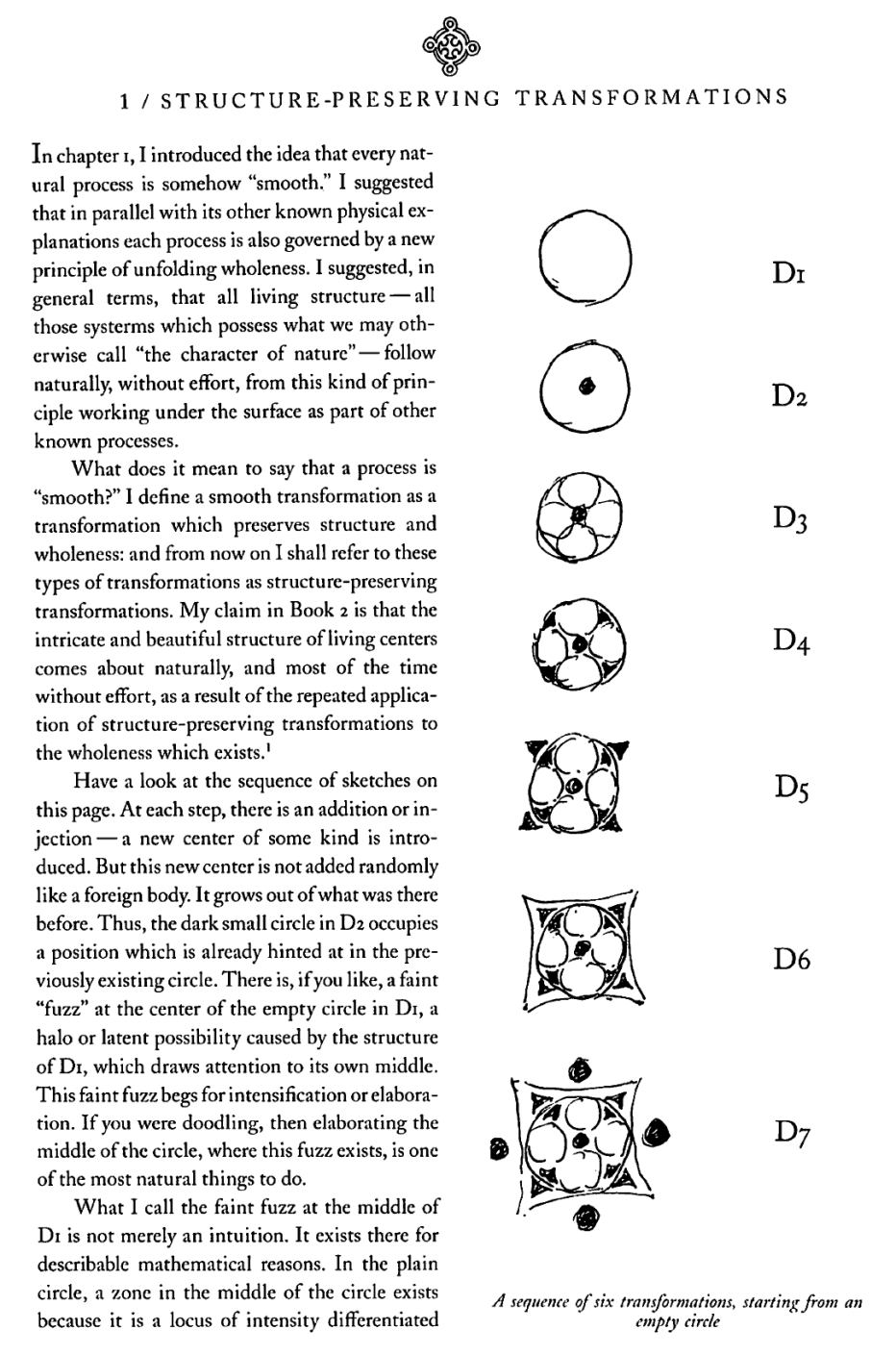
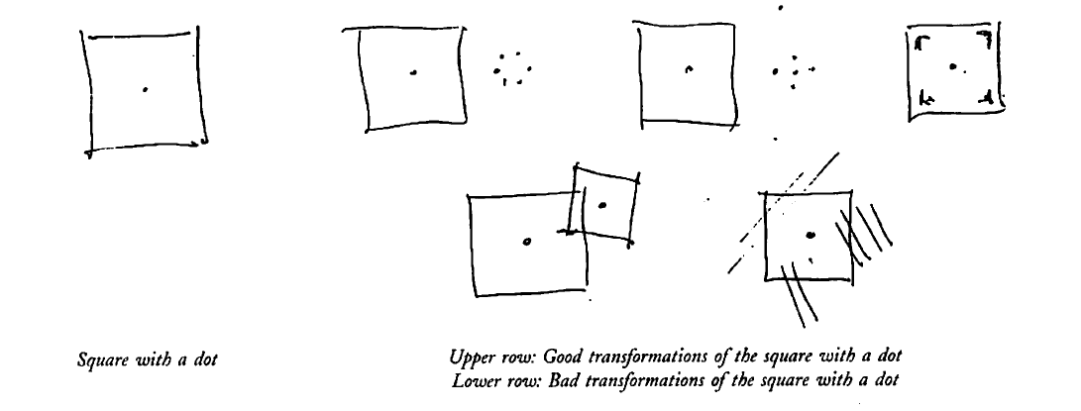
StructurePreservingTransformation. 대상 구조물의 wholeness를 보존한 채로 latent center를 살려가면서 구조물의 degree of life를 높여가는 것.
Structure를 destroy하는 transformation도 있다.
Teaching the Nature or Order. BuildingBeauty 학장(?)인 YodanRofé가 쓴 Teaching the Nature of Order
NPR 인터뷰. Chritopher Alexander's 'Nature of Order'
Book |
Chapter |
From |
To |
1 |
TOC |
9 |
9 |
1 |
Prologue |
17 |
20 |
1 |
Preface |
21 |
40 |
1 |
1 |
41 |
78 |
1 |
2 |
79 |
94 |
1 |
3 |
95 |
124 |
1 |
4 |
125 |
158 |
1 |
5 |
159 |
258 |
1 |
6 |
259 |
312 |
1 |
7 |
313 |
328 |
1 |
8 |
329 |
366 |
1 |
9 |
367 |
386 |
1 |
10 |
387 |
418 |
1 |
11 |
419 |
456 |
1 |
Conclusion |
457 |
460 |
1 |
Appendix |
461 |
488 |
2 |
TOC |
10 |
10 |
2 |
Preface |
11 |
34 |
2 |
1 |
35 |
70 |
2 |
2 |
71 |
104 |
2 |
3 |
105 |
126 |
2 |
4 |
127 |
156 |
2 |
5 |
157 |
194 |
2 |
6 |
195 |
222 |
2 |
7 |
223 |
248 |
2 |
8 |
249 |
268 |
2 |
9 |
269 |
286 |
2 |
10 |
287 |
318 |
2 |
11 |
319 |
342 |
2 |
12 |
343 |
360 |
2 |
13 |
361 |
388 |
2 |
14 |
389 |
420 |
2 |
15 |
421 |
450 |
2 |
16 |
451 |
480 |
2 |
17 |
481 |
514 |
2 |
18 |
515 |
530 |
2 |
19 |
531 |
550 |
2 |
20 |
551 |
570 |
2 |
21 |
571 |
583 |
2 |
Conclusion |
585 |
590 |
2 |
Appendix |
591 |
652 |
3 |
TOC |
11 |
11 |
3 |
Preface |
17 |
40 |
3 |
1 |
41 |
56 |
3 |
2 |
57 |
82 |
3 |
3 |
83 |
116 |
3 |
4 |
117 |
168 |
3 |
5 |
169 |
206 |
3 |
6 |
207 |
244 |
3 |
7 |
245 |
272 |
3 |
8 |
273 |
298 |
3 |
9 |
299 |
326 |
3 |
10 |
327 |
348 |
3 |
11 |
349 |
376 |
3 |
12 |
377 |
426 |
3 |
13 |
427 |
462 |
3 |
14 |
463 |
496 |
3 |
15 |
497 |
532 |
3 |
16 |
533 |
576 |
3 |
17 |
577 |
594 |
3 |
18 |
595 |
630 |
3 |
19 |
631 |
654 |
3 |
Summation |
655 |
692 |
3 |
Conclusion |
693 |
702 |
3 |
Appendix |
703 |
710 |
4 |
TOC |
12 |
12 |
4 |
Preface |
17 |
26 |
4 |
1 |
27 |
46 |
4 |
2 |
47 |
66 |
4 |
3 |
67 |
90 |
4 |
4 |
91 |
128 |
4 |
5 |
129 |
160 |
4 |
6 |
161 |
174 |
4 |
7 |
175 |
258 |
4 |
8 |
259 |
278 |
4 |
9 |
279 |
288 |
4 |
10 |
289 |
318 |
4 |
11 |
319 |
334 |
4 |
12 |
335 |
356 |
4 |
Epilogue |
357 |
370 |